Alopecia
Hair loss or baldness caused by hereditary disposition, illness, or any functional disorder is called alopecia in medical terms.

Understand key hair restoration and hair loss terms with this easy-to-read glossary.
Hair loss or baldness caused by hereditary disposition, illness, or any functional disorder is called alopecia in medical terms.
An autoimmune disease in which loss of hair occurs in some or all areas of the body is called alopecia areata. Since it causes bald spots on the scalp, it is also known as spot baldness.
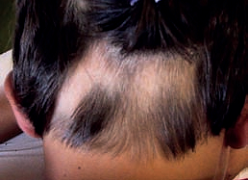
Loss of complete hair on the scalp is known as alopecia totalis. It is an advanced form of alopecia areata.
Androgenetic alopecia is the most common form of hair loss in both men and women. In men, this condition is called male-pattern baldness. Hair fall occurs in a well-defined pattern from above both temples, eventually receding to form a characteristic “M” shape.
The pattern of hair loss in women is different from that of men. In women, hair becomes thinner all over the head, but the hairline usually does not recede.
The complete loss of hair from the scalp and body is called alopecia universalis. It is an autoimmune condition in which a person’s own immune system attacks hair follicles. Itching and burning sensation are two common signs of alopecia universalis.
The growing phase of the hair growth cycle is called anagen. The duration of this phase usually lasts between one and seven years.
Loss of hair that is in the growing or anagen phase of the hair growth cycle is called anagen effluvium. This is usually caused by chemotherapy or radiation treatment.
It is a male hormone. Testosterone is the major androgen.
The second phase of the hair growth cycle is called the catagen phase. It comes after the anagen phase.
The area on the top back of the head that has a swirl or spiral pattern of hair is called the crown area. It is also known as the “Vertex”. Usually, the first sign of hair loss is seen here.
The outer layer of a hair is called the cuticle. It is the hair’s protective shield.
A structural formation at the base of hair follicles is called the dermal papilla. It provides oxygen and nutrients to hair follicles, ensuring healthy growth.
The second layer of the skin is called the dermis. It is the innermost layer.
It is a male hormone responsible for hair loss. DHT is created after the male hormone testosterone comes in contact with the enzyme 5-alpha reductase.
Direct Hair Implantation (DHI) is the most advanced hair transplant technique in which hair follicles are implanted one by one directly on the affected area of the scalp. Each hair follicle is placed by a DHI surgeon using unique single-use instruments that provide full control over direction, angle, and depth. DHI ensures natural-looking results and a high survival rate of follicles.
The hair transplanted by the DHI DirectTM technique do not fall out and grow naturally through one’s lifetime.
The lower back of the head where the density of hair usually remains thick for a lifetime is called the donor area.
Hair in the donor area are called donor hair. They are extracted and implanted to cover the scalp area suffering from hair loss.
The outer layer of the skin is called the epidermis. It is nonvascular.
It is a type of chemical. It transforms testosterone into dihydrotestosterone.
It blocks the action of the enzyme 5-alpha reductase and prevents the body from converting testosterone into DHT.
A hereditary pattern of hair loss in women is known as female pattern baldness. In this condition, women generally experience thinning of hair all over the head. Women do not usually experience a receding hairline.
Manufactured by Merck, the drug Proscar is also called Finasteride or Propecia. It is believed to be effective in the treatment of hair loss.
It is the root of hair below the surface of the scalp. It can look like a bulb and sheath where hair grows.
A group of one or more hair follicles is called a follicular unit. A follicular unit generally has 2.4 hairs.
Frontal Alopecia is characterized by the loss of hair at the front of the head.
Belonging or relating to genes received by each human, animal, and plant from its parents.
A procedure in which skin containing hair follicles is removed from the donor area and implanted in the recipient area. Minigrafting (3-8 hairs) and micrografting (1-2 hairs) are two popular methods of grafting.
Transplanted hair.
A strand of hair with its root is called a hair follicle. Hair follicles are extracted from the donor area and implanted into the recipient area.
It is a slang term for large round grafts. They are not used much nowadays.
A surgical procedure in which hair follicles are transferred from the lower back of the head to the recipient area by the surgeon.
A process in which a hair piece is attached to existing hair on the scalp.
A method proposed by Hamilton to rate the extent of hair loss.
It is a type of insoluble, tough, and fibrous protein that forms hair and skin.
One of the most common forms of hair loss in men, male-pattern baldness affects more than 50% of men over the age of 50. Hair falls in a well-defined pattern from above both temples, eventually receding to form a characteristic “M” shape.
Pigmenting granules present in the keratin fibre of the hair shaft. It determines the colour of the hair and reduces with age, resulting in gray or white hair.
A small hair graft that contains three to eight hair follicles.
Loss of hair without any scarring is called non-scarring alopecia. It is also known as noncicatricial alopecia.
A scale used to measure the extent of hair loss.
The area affected by hair loss or the area where donor hair is transplanted is called the recipient area.
A surgical treatment to remove scalp areas affected by alopecia. The main purpose is to reduce the overall bald area from the scalp.
Stitch.
The resting phase of the hair growth cycle is called telogen. It lasts for 3 months.
This is the second most common form of hair loss after androgenic alopecia. In this condition, hairs enter into the telogen phase.
Loss of hair in the telogen phase is called telogen loss. It is also called the natural loss of hair.
Male hormone responsible for the development of male characteristics.
As the name suggests, this type of hair loss is caused by traction applied to hair. It is commonly associated with braiding, ponytails, and other hairstyles that put pressure on hair.
Hair loss caused by constant pulling and twirling is called trichotillomania.
The crown area of the scalp is also called the vertex.