


How Many Grafts Do You Need for a Hair Transplant? A Complete Guide
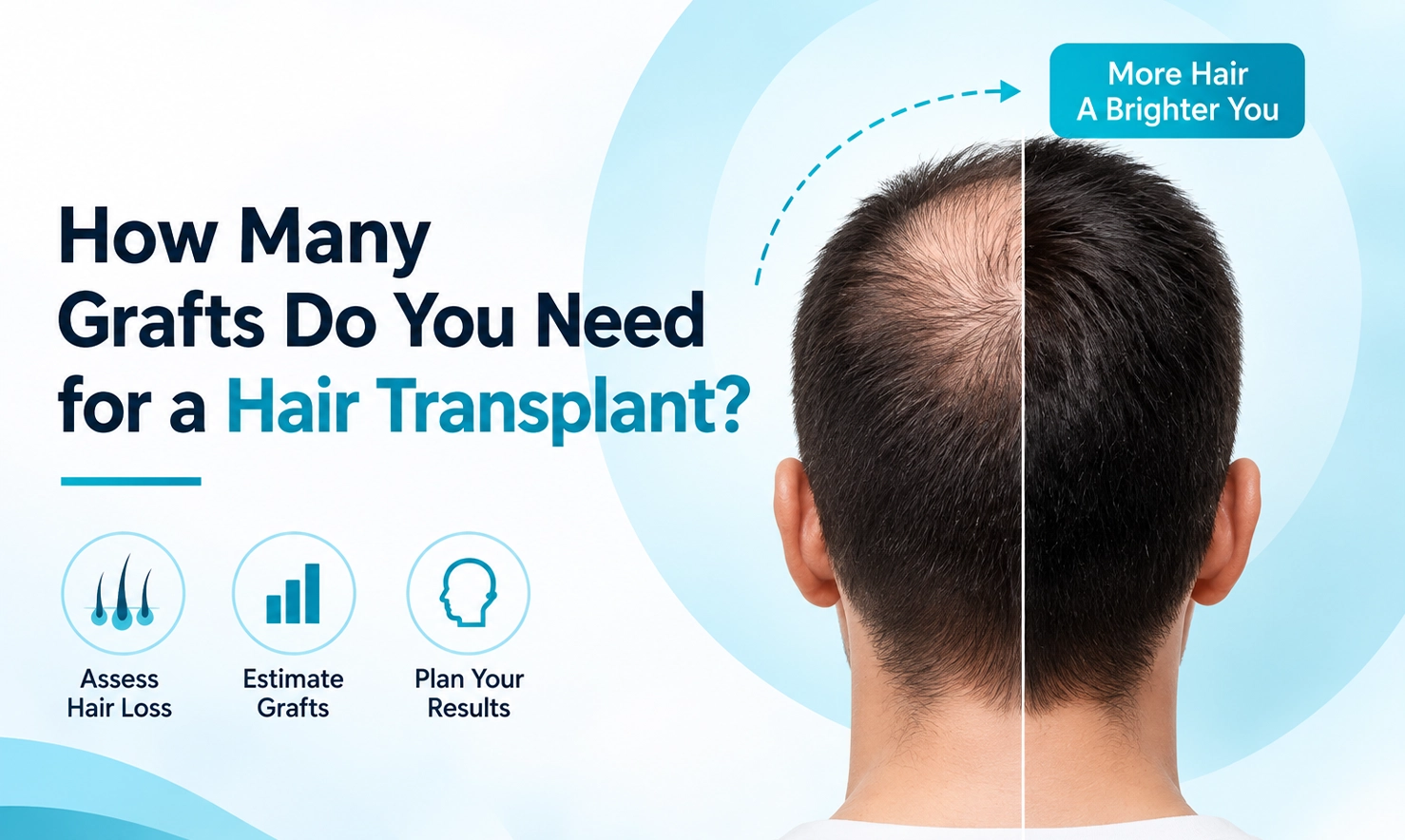
If you are researching hair restoration, how many grafts do I need for a hair transplant is usually the first question that comes up right after, will this actually work for me? The honest answer is that it depends on your hair loss pattern, donor supply, and the look you want. Here’s how surgeons actually arrive at a number.
What is a Hair Graft?
A hair graft is a small piece of tissue containing a natural grouping of 1 to 4 hair follicles that is moved from a donor area to a thinning or bald spot during a hair transplant surgery.
Factors That Decide Your Graft Count
Graft requirements differ from person to person. A surgeon looks at several factors
- Extent and pattern of hair loss — a receding hairline needs far fewer grafts than advanced diffuse thinning.
- Donor area health and density — a thicker, healthier donor zone allows more grafts to be safely harvested.
- Hair characteristics — coarser or curlier hair covers the scalp better, so it often needs fewer grafts for the same visual density.
- Personal density goals — a subtle, natural fill uses fewer grafts than a thick, maximum-density result.
Average Number of Grafts for Hair Transplant Calculated by Norwood Stage
Different regions of the scalp need different densities to look natural, and male pattern baldness is commonly measured against this using the Norwood Scale. It can help give you an initial idea of the average number of grafts for a hair transplant you may need. It can also give you a rough starting point for understanding how many grafts for a hair transplant may be needed before a formal consultation.
Average Grafts Needed by Norwood Stage
| Norwood Stage | Area Affected | Approx. Grafts Needed |
| 2 | Temples | 500–800 |
| 2a | Center of scalp | 500–1,000 |
| 3 | Front + temples | 1,000–1,500 |
| 3a | Front + crown | Front: 1,000–1,500 / Crown: 500–1,000 |
| 4 | Front + crown | Front: 1,200–1,600 / Crown: 800–1,100 |
| 4a | Front of head | 1,700–2,500 |
| 5 | Front + crown | Front: 1,800–2,200 / Crown: 1,000–1,500 |
| 6+ | Front + crown | Front: 1,800–2,500 / Crown: 1,500–1,700 |
How the Hair Transplant Grafts Calculator Works
A hair transplant grafts calculator can give you a quick estimate of how many grafts you need based on your hair loss. However, it cannot replace a consultation or a surgeon’s assessment of your donor area and desired coverage.
Clinics such as DHI® have built their own version of this tool to help candidates understand the extent of their hair loss, plan for expected costs, and get a starting graft estimate before ever stepping into a clinic. Most clinic calculators follow the same three-step process
1. Select your hair loss type — male pattern, female pattern, or eyebrow reconstruction.
2. Enter basic details — age and ethnicity, which can provide context for individual follicle characteristics and hair density expectations.
3. Mark your areas of hair loss — the calculator uses this to estimate your current stage on the Norwood Scale, and the graft count that stage typically needs.
Based on these inputs, the tool returns an estimated graft range and a rough cost estimate, giving you a solid starting point for how many grafts you are likely to need for a hair transplant.
Why the Final Number Still Needs a Doctor’s Assessment
A hair transplant grafts calculator can only work from what you tell it, not what your scalp can actually support. Two things it can’t measure.
- Donor area supply — checked in person via scalp biopsy or density mapping, not self-reported inputs.
- Miniaturization patterns — hair that’s thinning but not yet fully lost, which changes how future-proofed the plan needs to be.
This is why the average number of grafts for hair transplant shown by any calculator is a range, not a final result. Surgeon expertise, the treatment technique used, and the extent of hair loss all factor into the graft count and the eventual cost per graft.
The real answer to how many grafts are needed for a hair transplant in your case is confirmed only after a surgeon examines your donor zone directly.
At DHI®, this step happens through a dedicated consultation, in person before your treatment plan is finalized.
Why You Should Choose DHI®
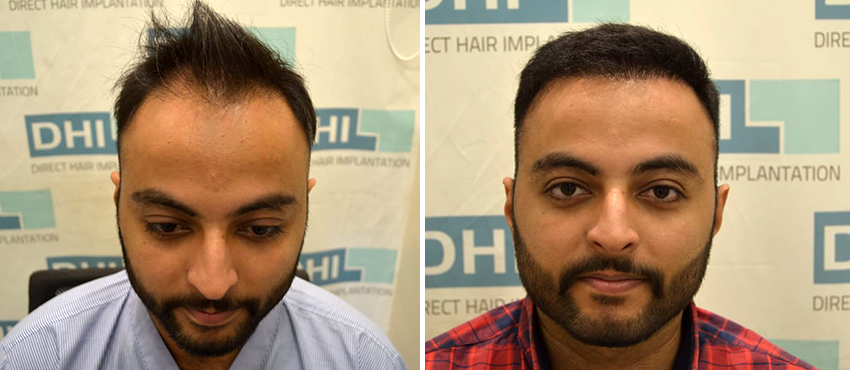
Graft count only tells half the story, how each graft is placed determines whether that number actually shows up as visible density. DHI® addresses this at the placement stage; each follicle is inserted directly into the scalp through a patented technique that sets angle, depth, and direction in a single motion, reducing the time follicles spend outside the body and improving survival per graft.
DHI® has been active in hair restoration for more than 50 years and is recognized by ISO, the UK Care Quality Commission, and TUV Austria. Every DHI® procedure is performed by surgeons trained and certified through the London Hair Restoration Training Academy, with reported graft viability of 97 percent.
A consultation with a certified DHI® surgeon is the most reliable way to convert an estimated graft range into a confirmed treatment plan.